
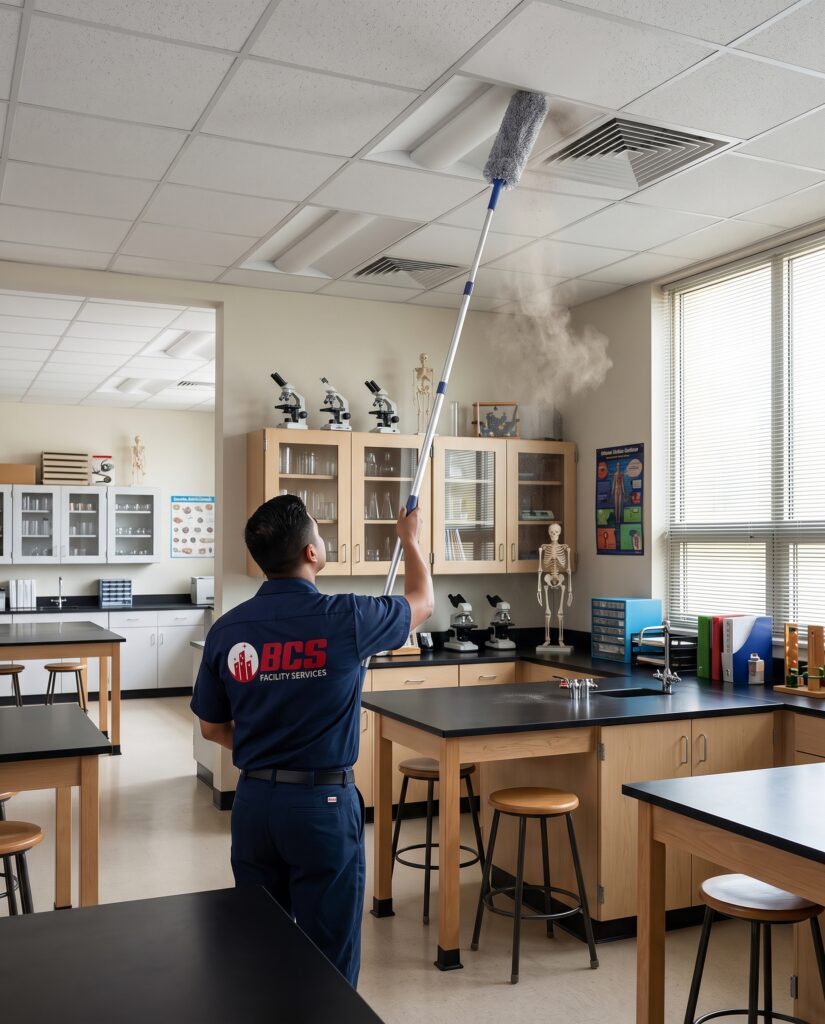
Dust rarely arrives in a classroom all at once. It enters through doors, settles after students move around, collects on furniture, and gradually builds up in places that may not receive attention during a routine cleaning pass.
For Newington schools, reducing that buildup requires more than simply wiping visible surfaces. A practical classroom dust control strategy considers where particles settle, how rooms are used, and which cleaning tasks need to happen regularly.
Follow the Dust Trail
One useful way to approach classroom cleaning is to look for the path dust takes.
Start near the entrance.
Floors around classroom doors can collect particles tracked in from corridors. From there, dust can move toward desks, chair legs, storage areas, and other surfaces as people walk through the room.
Facility teams can pay particular attention to:
- Floor edges and corners
- Areas beneath desks and chairs
- Window sills
- Shelving
- Cabinet tops
- Technology surfaces
- Baseboards
- Vent and diffuser surroundings
Newington’s facility documentation specifically recognizes high dusting as a recurring maintenance task, including areas such as sills, louvers, doors, return-air vents, and light fixtures.
Change the Order, Not Just the Frequency
Cleaning more often does not automatically solve every dust problem.
The order of tasks matters.
If shelves and other elevated surfaces are cleaned after floors have already been serviced, falling particles can create additional work. A more practical sequence begins with higher surfaces and works downward.
For example:
High surfaces → furniture → lower surfaces → floors
This simple progression can help prevent dust from being redistributed onto areas that have already been cleaned.
Give Hidden Areas Their Own Schedule
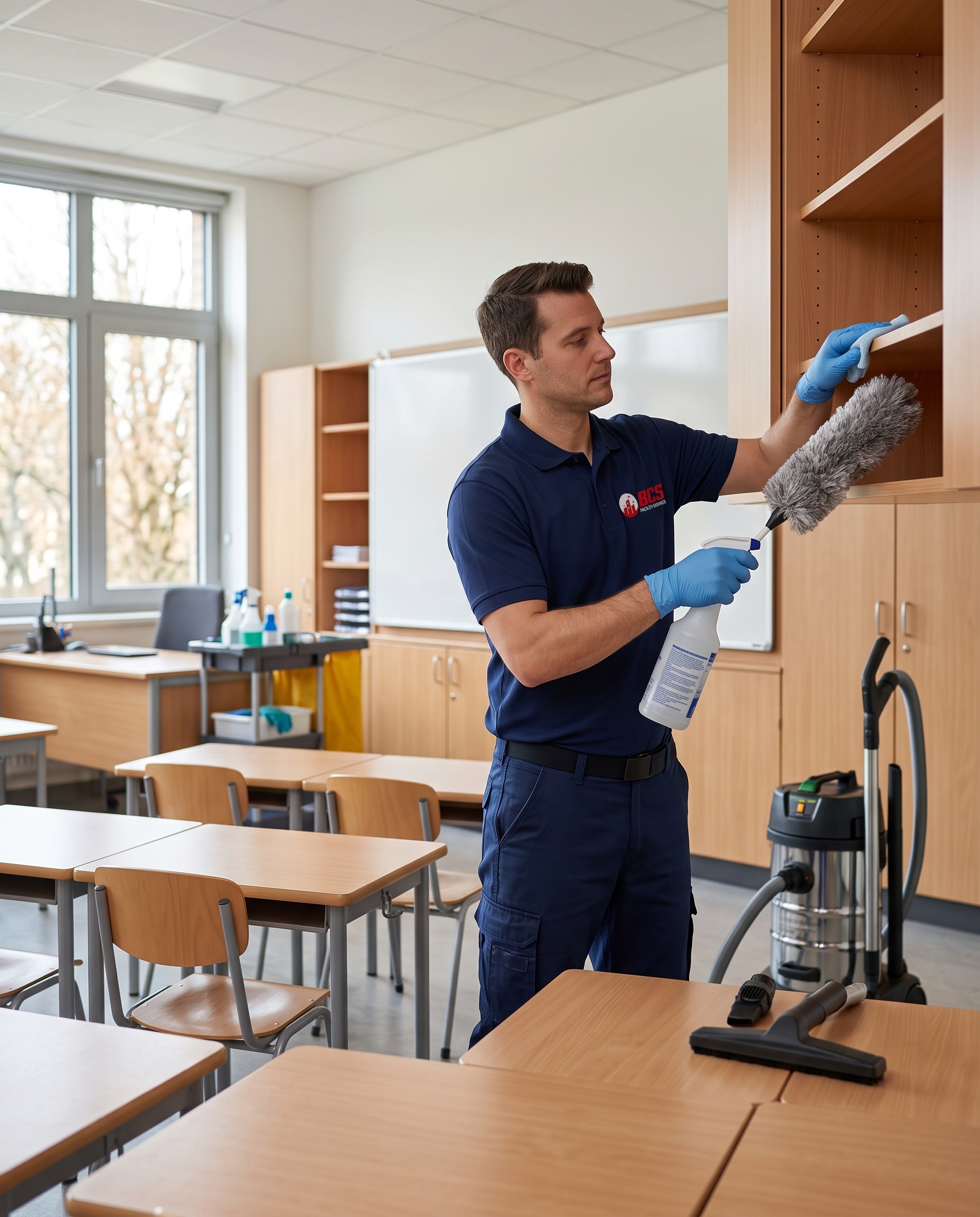
Some dust accumulates outside the normal eye level.
Storage shelves, cabinet tops, behind furniture, and corners underneath tables can gradually collect particles. These locations may not need attention every day, but they should have a defined place within the recurring maintenance schedule.
Newington’s facilities information describes daily cleaning alongside preventive maintenance as part of its broader building-management responsibilities. A dust-control routine can fit within that larger maintenance structure by assigning less-visible areas to periodic service.
Watch What Happens During the School Day
Classrooms are active environments.
Students move between desks, teachers rearrange materials, doors open and close, and supplies are frequently handled. Those activities can disturb settled dust and move particles onto other surfaces.
This means facility teams can benefit from observing which rooms or areas accumulate dust more quickly.
A classroom beside a busy corridor may require a different approach from a room used less frequently. Art rooms, technology spaces, and classrooms with extensive shelving may also have different dust-collection points.
The goal is to base classroom dust control on actual room conditions rather than applying exactly the same routine everywhere.
A Local Example Beyond Newington
Dust-management principles are useful across different school environments. Even when providing school cleaning in Bloomfield, Burgos Cleaning can tailor classroom care to the room’s layout, traffic, furniture, and cleaning requirements.
That same flexible approach can benefit Newington schools: assess the space first, identify recurring dust points, then build those observations into the cleaning schedule.
Make Prevention Part of the Routine
Dust control is easier when small actions are repeated consistently.
Teams can inspect entry areas, address floor debris before it spreads, clean elevated surfaces on a planned rotation, and avoid overlooking furniture edges and concealed spaces.
Burgos Cleaning approaches school cleaning as a service that can be adjusted around the needs of classrooms, hallways, cafeterias, and other educational spaces.
For Newington facility teams, the objective is straightforward: identify where dust settles, understand what moves it, and build those findings into the daily and periodic cleaning routine.
With a thoughtful classroom dust control plan, classrooms can receive more targeted attention without turning every cleaning shift into a full deep-cleaning operation.