
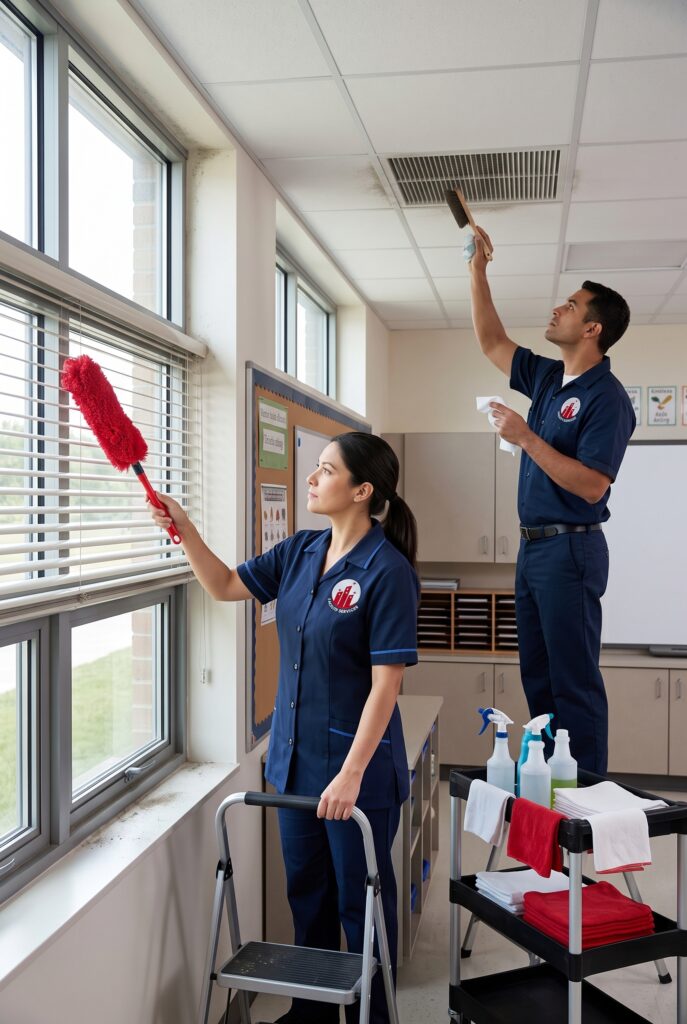
A busy school day rarely leaves a classroom in the same condition it was in that morning. Desks shift during group activities, papers collect around workstations, students move between rooms, and small spills or debris can appear throughout the day. A classroom cleaning routine needs to account for those changes instead of relying on one fixed cleaning period.
At Burgos Cleaning, we approach school cleaning by looking at how each space is actually used. When cleaning schedules follow classroom activity, facility teams can address problems at practical points throughout the school day without disrupting instruction.
Start With the Room’s Reset Points
Not every cleaning task needs to happen at the same time.
Classrooms usually have several natural reset points:
- Before students arrive
- During longer breaks
- After major classroom activities
- At the end of the school day
Each point can serve a different purpose. The morning reset can involve checking floors, arranging desks, removing leftover debris, and preparing frequently handled surfaces for the day ahead.
Rather than attempting every task at once, Burgos Cleaning recommends dividing responsibilities according to when the classroom is most accessible.
Match Cleaning to Classroom Activities
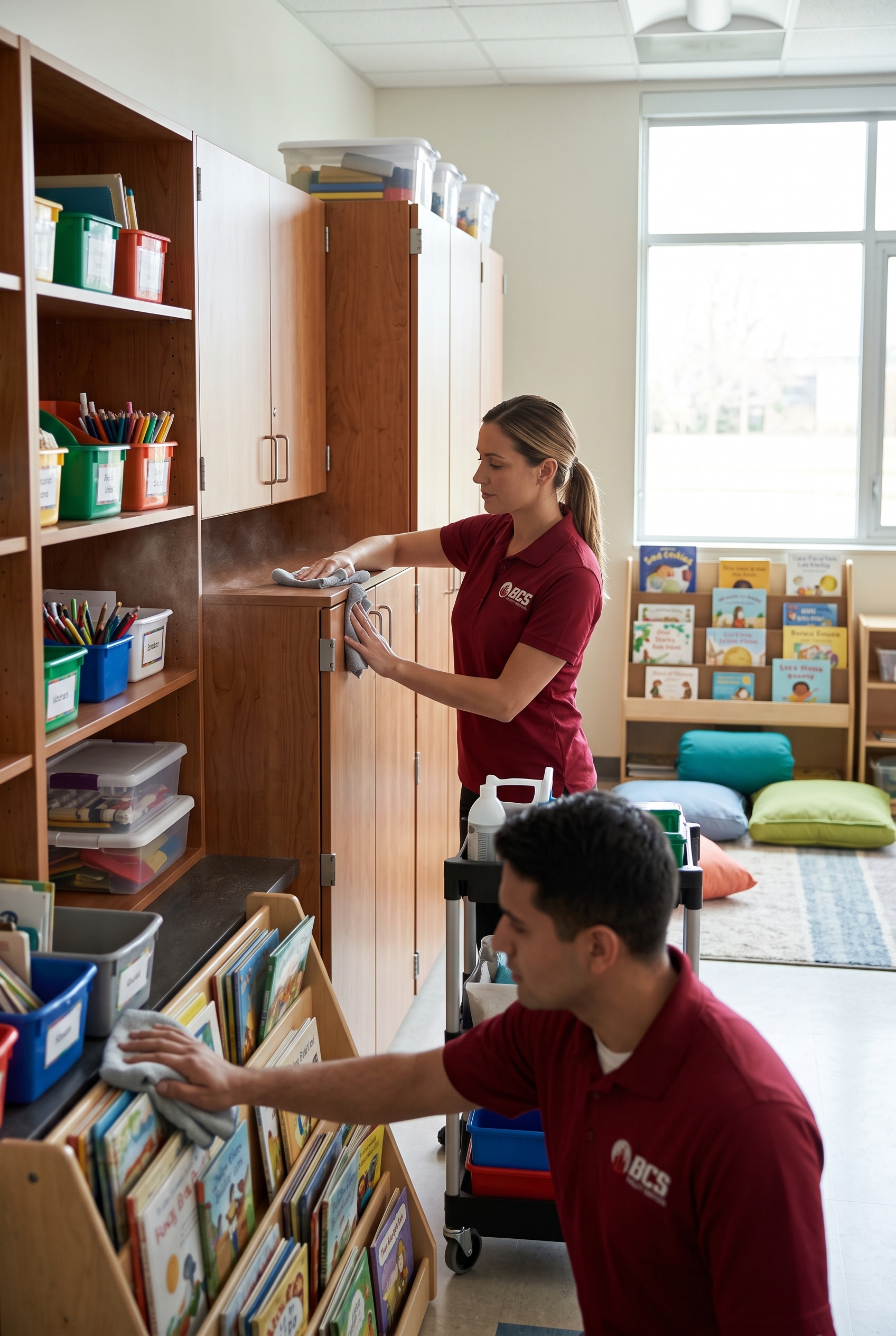
A science classroom can generate different cleaning needs from a traditional lecture room. Art projects may leave behind paper scraps and material residue, while technology rooms can involve shared equipment and workstation surfaces.
That is why we do not view every classroom as identical.
Rooms used for hands-on projects may need greater attention around work surfaces and floors. Classrooms that regularly involve group activities may require more frequent attention to desks, chairs, and shared areas.
This activity-based approach makes classroom cleaning more practical because the routine responds to actual room conditions.
Use the Five-Minute Window
A short break between activities may not provide enough time for complete cleaning, but it can still provide an opportunity for small corrections.
Loose paper can be collected. A minor spill can be addressed. Desks can be returned to position. A waste container that is approaching capacity can be emptied or reported.
At Burgos Cleaning, we see these small interventions as part of a larger cleaning rhythm. Addressing minor issues early can reduce the amount of work required during the more detailed end-of-day service.
Give Floors Their Own Schedule
Floors often tell the story of how heavily a classroom has been used.
A room with frequent student movement may collect debris faster than a classroom with limited activity. Outdoor programs can also introduce additional dirt and particles into certain spaces.
For Farmington schools, floor care can therefore be scheduled according to classroom use rather than applying precisely the same frequency everywhere.
Sweeping, vacuuming, mopping, and periodic deeper floor care can each have a defined place within the facility’s cleaning plan.
Schools seeking school cleaning in Farmington can also consider classroom size, student activity, flooring materials, and daily schedules when establishing floor-care routines.
Build Around the Final Bell
Once students leave, cleaning teams have greater freedom to complete detailed work.
This is the time to remove classroom waste, reset desks and chairs, address floors, clean appropriate high-contact surfaces, and prepare the room for the following school day.
Burgos Cleaning builds cleaning routines around this transition because the final bell creates a natural point for restoring classrooms without competing with instruction.
Adjust When the Schedule Changes
No two school days are exactly alike.
Assemblies, testing, special projects, substitute classes, extracurricular programs, and after-school activities can all change how a classroom is used.
A classroom that hosted an art project may require a different service routine from one used for a standard lesson. Likewise, a room occupied after school may need an additional reset before the next morning.
Our approach at Burgos Cleaning is to treat the cleaning schedule as a working system rather than a rigid list that cannot change.
A Cleaner Classroom Starts With Timing
Maintaining cleaner classrooms during busy school days does not always mean adding more cleaning tasks. Often, the greater improvement comes from performing the right task at the right time.
For schools in Farmington, an activity-based routine can create a more manageable rhythm: prepare the classroom before use, address small issues when opportunities arise, and complete detailed service after daily activity has ended.
That is the approach Burgos Cleaning brings to school facilities—cleaning around the rhythm of the building so classrooms are ready for students, teachers, and the next school day.